 Add to Chrome
 Add to Firefox
 Add to Edge
Your AI-Generated Image Detector Can Secretly Achieve SOTA Accuracy, If Calibrated
Feb 02, 2026
Despite being trained on balanced datasets, existing AI-generated image detectors often exhibit systematic bias at test time, frequently misclassifying fake images as real. We hypothesize that this behavior stems from distributional shift in fake samples and implicit priors learned during training. Specifically, models tend to overfit to superficial artifacts that do not generalize well across different generation methods, leading to a misaligned decision threshold when faced with test-time distribution shift. To address this, we propose a theoretically grounded post-hoc calibration framework based on Bayesian decision theory. In particular, we introduce a learnable scalar correction to the model's logits, optimized on a small validation set from the target distribution while keeping the backbone frozen. This parametric adjustment compensates for distributional shift in model output, realigning the decision boundary even without requiring ground-truth labels. Experiments on challenging benchmarks show that our approach significantly improves robustness without retraining, offering a lightweight and principled solution for reliable and adaptive AI-generated image detection in the open world. Code is available at https://github.com/muliyangm/AIGI-Det-Calib.

Understanding and Improving Early Stopping for Learning with Noisy Labels
Jun 30, 2021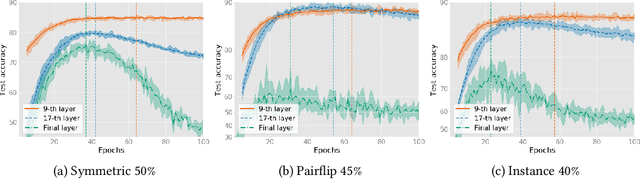
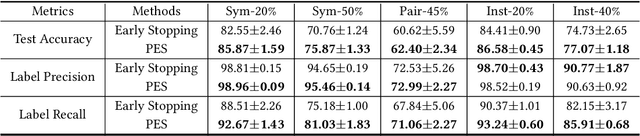
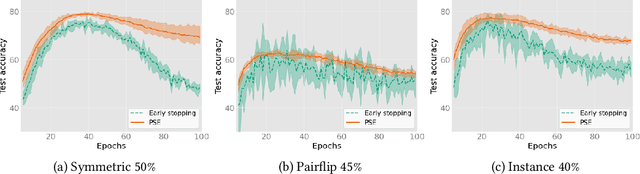
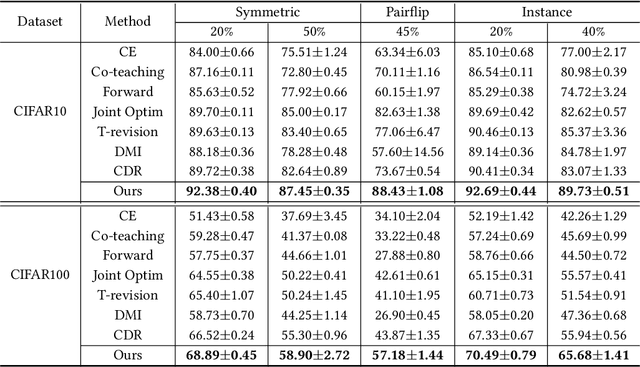
The memorization effect of deep neural network (DNN) plays a pivotal role in many state-of-the-art label-noise learning methods. To exploit this property, the early stopping trick, which stops the optimization at the early stage of training, is usually adopted. Current methods generally decide the early stopping point by considering a DNN as a whole. However, a DNN can be considered as a composition of a series of layers, and we find that the latter layers in a DNN are much more sensitive to label noise, while their former counterparts are quite robust. Therefore, selecting a stopping point for the whole network may make different DNN layers antagonistically affected each other, thus degrading the final performance. In this paper, we propose to separate a DNN into different parts and progressively train them to address this problem. Instead of the early stopping, which trains a whole DNN all at once, we initially train former DNN layers by optimizing the DNN with a relatively large number of epochs. During training, we progressively train the latter DNN layers by using a smaller number of epochs with the preceding layers fixed to counteract the impact of noisy labels. We term the proposed method as progressive early stopping (PES). Despite its simplicity, compared with the early stopping, PES can help to obtain more promising and stable results. Furthermore, by combining PES with existing approaches on noisy label training, we achieve state-of-the-art performance on image classification benchmarks.